Search This Blog

Showing posts with label Green Tea. Show all posts

Friday, August 6, 2010

Green Tea: Production Process

Baby tea buds and leaves on the tea bush
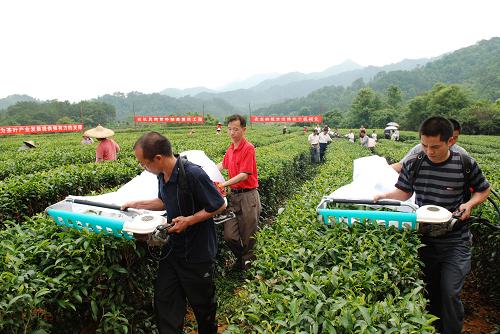
Machine-picking


hand-picking

Fresh budsets after picking

Machine production (1)

Machine production (2)


pan-firing

Firing and shaping the tea leaves by hand

Longjing (Dragon Well) tea ready to drink


Would you like a cup?

To be able to appreciate the aroma and flavor of tea from little sips is a great pleasure; to understand a little of the art of tea manufacture definitely enhances the experience of drinking.

In general, green teas are produced by one of four methods: pan-firing, oven-drying, sun-drying and steaming (炒青、烘青、曬青和蒸青). Each of these methods incorporates the same underlying processes: plucking, primary drying (called sha qing [lit: "killing the green"] in Chinese), rolling, and drying (採摘, 殺青、揉捻、乾燥).

1. Plucking
                                                                 
Machine-pick
There are three main methods to pick (or pluck) fresh tea leaves: hand-picking (single-hand-pick and double-hand-pick), knife-picking, and machine-picking. In terms of efficiency, a double-hand-pick is roughly two times faster than a single-hand-pick, knife-picking is about 10 times faster than hand-picking, and machine-picking is about 80 times faster than hand-picking. The single-hand method of picking is only used for the highest grades of green tea or for tea harvested for personal use by local growers (e.g. my family). The knife-picking and machine-picking methods are more popular and appropriate for big tea companies.
                                                                     
A nice tea education (It reminds me of my childhood)
This reminds me of my own childhood experience of tea production. When I was about 10 years old, I helped my parents and neighbors to pick fresh tea leaves; I was responsible for lighting the fires and preparing everything for the pan-firing process; I selected the best-quality tea leaves for rolling (to help shape and dry the tea - of course, my mother was my teacher and demonstrated this technique to me). It was a hard job, and just picking tea leaves was enough to demand all my energy. I used the single-hand-pick method, in which the left hand holds the tea stem while the right hand picks the tea leaves. My eyes was busy for looking for baby budsets with one bud and one leaf.  I picked about 3 pounds in about 4 hours. (To put this in perspective, 1 pound of dry loose tea needs more than 5 pounds of primary tea leaf. To make 500g of the best quality Biluochun [Green Snail Spring] requires about 68,000-74,000 fresh baby buds,while around 30,000 baby buds are needed for the same amount of the best Longjing [Dragon well]. Why the difference? The buds used for Longjing are bigger.) After a day's work during the tea harvest, everywhere on my body was hurting. I was exhausted, hungry, and thirsty. Yet, I still enjoyed it.

2. Primary Drying
A family hand-processing tea (I miss my parents' tea)

This process is the key to maintaining the natural green color of the tea leaves and liquor. Heat (either dry heat from a pan, tumbler or oven, or steam - which is commonly used in Japan) is applied to arrest any further activity of the enzymatic compounds in the primary leaf and thereby prevent oxidation. This process not only keeps the leaves green, but also increases leaf flexibility, thereby creating a better condition for the next procedure - rolling. Moreover, it helps to remove any grassy odor from the tea and enhance its fragrance.

A special high-grade green tea must be produced by hand in a basket or large wok, but most green teas produced commercially are made largely by machine.

3. Rolling - Shaping                                                                
pan-firing

This process imparts a distinctive shape (such as flat or twisted) to the tea leaves and breaks the cell walls inside each leaf, to reduce the bitterness and astringency of the tea.

4. Drying

This not only removes the moisture from the tea leaves, but also stabilizes the shape, appearance and quality of the tea, and helps to develop its aroma.

There are three common ways to dry green tea in China: pan-firing, oven-drying and sun-drying. The most famous pan-fired green teas are Longjing (龙井) and Biluochun (碧螺春), mentioned above. The most famous oven-dried green teas are Huangshan Maofeng (黄山毛峰 "Yellow Mountain Fur Peak") and Taiping Houkui (太平猴魁 "Great Peaceful Monkey Chief"). A typical Sun-dried green tea is Dian Qing (滇青 "Yunnan Green") from Yunnan.

In summary, each of these process can be done by hand, partly by hand and by machine, or entirely by machine. The quality and character of any given tea really depends on the technique and taste of the production master, whether produced by hand or machine. Of course, the best quality tea is usually produced by hand.

Since green tea is a fresh product, it should be enjoyed while it's still fresh and full of the life and art carefully brought out by the artisans who produced it. That's why I'm almost out of mine! I'll just have to survive on Pu'er and Oolong until next spring. Later, I'll write something about how their production is different from that of green tea. Bye for now!

Sunday, December 13, 2009

Preparation of Green Tea


Some people who have tried Chinese or other green teas have expressed to me that they found green tea bitter, rough and astringent. Well, green tea is not supposed to taste like that. The right taste should be fresh, clean and delicate with a sweet aftertaste.

Green tea needs more care and cautiousness to prepare than other teas. Why? A good quality loose green tea must be picked by hand in early spring. The tea leaves are very young, tender and consist of either one baby bud or one bud and one or two baby leaves. This means that green tea is a delicate, fresh product, and that proper preparation is essential to savor the tea.

Here are the details regarding preparation:

1. Tea implements:

Glassware (glass cup, glass pot) for high-quality, young, tiny and tender loose tea. The transparency of glass also invites you to enjoy the graceful tea dancing. A porcelain cup with a lid (gaiwan) is also suitable.

TIP: After filling the cup, pot or gaiwan with hot water, do not cover it - let the tea breathe. Otherwise, too much heat will overcook the tea.

2. Water temperature:

175-185°F for loose green tea (even cooler [140-150°F] for a powdered tea like matcha).
If the water temperature is too high, the tea will be overcooked, which means it will be bitter, heavy and astringent. This will also affect any subsequent brews, so the flavor of the tea has been effectively ruined. Conversely, if the water temperature is too low, the taste will be too thin and light.

3. Quantity of tea leaves:

A generous amount would be 2 full teaspoons per cup. However, this is also based on individual taste. If too much tea is added, the taste is likely to be bitter, heavy and a waste of tea leaves. If too little tea is added, the flavor will be too light and thin. Either way, the full taste of natural green tea has been lost. As you can imagine, a little practice is necessary before you can brew a perfect cup of any given variety of green tea - or any other tea, for that matter.

4. Steeping time:

In general, a single cup of tea should be brewed for about one minute; the time for a gaiwan is about 30 seconds for the first brew, extended by 5 to 10 seconds for each subsequent infusion.

TIP: if you brew green tea in a drinking glass, do not let the tea sit in the water too long, otherwise it will become bitter. This problem can be easily addressed through the use of a strainer or filter to remove the tea leaves. However, the taste of metal or plastic can leach into the tea, so be careful!

5. How to add water for multiple steepings:

As green tea is typically composed of young leaves, they can be steeped only 3-4 times. The second infusion generally has the best taste.
When brewing tea in a glass, some water should be left in the bottom so the tea is never left entirely dry; this water is allowed to cool down, and helps protect the tea from the heat of subsequent infusions. However, when brewing with a gaiwan, the tea water should be poured off completely with each infusion.

One more TIP: spring water is the best for infusion, don't boil the same water over and over.

In summary, the key to prepare a tasty green tea is to control the water temperature and not to steep the tea too long.

Hope that was helpful. Next I'll write something about oolong tea.

Thursday, December 10, 2009

How to choose a good green tea


When we consider another person, we might base our assessment either on the person’s outer qualities or inner qualities, or perhaps both – which is what one does to identify the quality of tea: consider both appearance and character.

Let’s start with appearance first.

The most basic requirement is that the tea leaf must be a whole leaf. The appearance of a given kind of tea should have a standard pattern. No matter what its particular shape, size and color happen to be, they should all be consistent. The maturity of tea leaves should be even. The color should be vivid. If the general appearance is bright, the size, thickness and length are even, it means it is a superior fresh green tea; if the tea leaf is dry, dull and dark, its appearance is not uniform, uneven and perhaps even has been mixed together with tea stems or tea seeds, this is a poor quality tea.
Typically, a tiny, tight, wiry shape with many baby buds indicates that a tea is young and tender. Coarse, loose, broken and/or old leaves (no tea buds or baby tea leaves) show that the tea is too mature (太平猴魁 Taiping Houkui and 六安瓜片 Liuan Guapian are notable exceptions).

To appreciate a tea's inner qualities, you have to brew the tea, smell the aroma, observe the liquor color, inspect the infused leaves, and of course to taste the tea.

Aroma: A floral, delicate aroma is best, with a young, fresh, clean fragrance; nutty and/or fruity notes also indicate excellence; an aroma that is weak, stale, dull, flat, heavy or harsh indicates poor quality; a burnt, musty or otherwise unpleasant odor clearly indicates that a tea has either been improperly processed, stored, or both.

Liquor (or, if you prefer, infusion): The color should be light green or light yellow green, clear and bright; color that is too yellow, deep, dull or turbid indicates a poor quality tea.

Taste: A green tea should have a fresh, mellow, sweet taste, and a superior tea will also have a similar aftertaste; a thin, bitter, rough, astringent taste or aftertaste indicates either an inferior tea, or perhaps improper preparation, in some cases.

Infused leaf: A green tea should have tender leaves with many buds, which should be thick, soft, even and neat; leaves that are rough to the touch, visibly uneven, old, hard and/or thin show that both the raw material and processing are mediocre.

Some people have asked me whether the fresher green tea is means the better it is. The answer is that it depends on time of the year. The best green tea is plucked in early spring and the worst is harvested in summer (I use the word "harvested" instead of "plucked" because summer teas are typically harvested with machines rather than by hand, as the locals won't drink them; they're used for cheap tea sold overseas). There is an old Chinese saying: "Tea around Qingming (清明, on 04 April) is treasure, tea after Guyu (谷雨, on 20 April) is grass." This is absolutely right. Basically, if green tea is picked and processed after Guyu, close to Lixia (立夏, 05 May) or the beginning of summer is the poorest quality tea.

Of course, even if you have a superior green tea, you won't appreciate its inner beauty if you don't know how to prepare it properly. I'll write something simple about that in my next post.

Hope this was interesting. If there's anything in particular you'd like to know about, please let me know!


Monday, December 7, 2009

What is Green Tea?


Green tea also called unfermented tea. It originates from China and is not only the earliest tea in Chinese history but has also become associated with many cultures in Asia from Japan to the Middle East. 70% of all tea produced in China is Green tea. There are tea gardens in more than 1000 cities and towns. Green tea makes up about 23% of the world tea market and more than 70% of all green tea produced internationally comes from China.

There are many different varieties of green tea. Different tea cultivars, environments (terroir) and different production processes create different types of green tea. It is estimated that there are currently more than 900 kinds of green tea in China.

Green tea is the type of tea closest to nature. After the tea leaves are picked, they are processed with only three steps: 1) a brief exposure to heat in order to keep the leaf green by preventing oxidation, then 2) rolling or twisting the leaf to break its cell walls and provide shape and finally 3) drying to remove most - but not all - of the moisture and determine a given tea's distinctive aroma. A process with only three steps might seem simple, but the result depends on the details.

After this process is complete, a tea with a particular personality emerges, just like you and me. Some leaves are long and some are short; some are flat and some are twisted; some are shaped to look like a sparrow's tongue, others to look like an orchid. The basic taste of green tea is clear, fresh and brisk, like the feeling after the rain. A well-made green tea isn't bitter, rough or astringent. Some are nutty, some are flowery and all have a slightly sweet aftertaste.

In my next post, I'll write a little about how to select a high-quality green tea. I know these first few posts are too simple for some of you who already know about tea, but I think it's good to start with the basics; then we can have a more detailed conversation.

Enjoy your tea!

About Me

My photo
Seattle, WA, United States
I grew up with tea, and it continues to fill my life with so much beauty and discovery, pleasure, peace and friends. It is always leading me toward a greater understanding of culture, nature, myself and others. It is my hope to use this space to share the joy of tea and tea culture with you.