I was so excited! One of my friends invited me to taste a puerh tea produced in the 1980s. The cake had just arrived from China, and in a week we would meet to share it together. This week seemed neverending. When the date we set finally arrived, I raced to his place for a taste of something genuinely special.
After eagerly opening the paper wrapper, I noticed some white spots spread unevenly over the surface of the tea. This elicited my first concern about its quality. Raising the cake for better inspection, my excitement was stifled by the odor of mold. This stink was immediate and conclusive proof that the tea had been tainted due to poor storage. I didn't want to disappoint my friend so quickly and kept my silence as I carefully separated the cake and prepared the tea. The liquor was dull and dark like ink. The flavor was muddy and moldy. It all confirmed my original suspicion that the tea had been contaminated.
How did this happen? The tea was stored in an overly warm and moist environment, either due to negligence or perhaps to hasten fermentation. As a result, the amount of moisture the tea absorbed rose over 10% of its total mass, creating felicitous conditions for growing mold. In China, it is not unusual to use warmth and moisture to mature puerh while it is in storage, although they are supposed to be controlled. We even have a professional term for this: "wet-stored" (shicang 湿仓) puerh. As one might suspect, the alternative is known as "dry-stored" (gancang 干仓) puerh.
Of course, it is both very disappointing and frustrating to age a cake for decades, only to grow mold, or produce what should have been a delicacy and is now only compost. So what are the significant points we should know to store our tea properly?
1. Air Circulation is necessary
Don't store puerh in a plastic bag or airtight container, because the microbes that cause fermentation need to breathe. Constant and regular air circulation will help the tea develop and blow away odors. However, puerh should not be kept anywhere breezy (e.g. next to a window, doorway, or on a balcony), as the wind will carry its aroma and flavor away. In sum, moderate air flow is important, but drafts should be avoided.
2. Constant Temperature is necessary
The best temperature to store puerh is between 68-86°F (20-30° C). If the temperature is too high, it will affect the mouthfeel. The taste could become dull, flat or sour. In addition, raw (sheng 生) puerh will sometimes develop into cooked (shu 熟) puerh (this has been reported for tea stored in Hong Kong). This means a normal indoor temperature for us would be suitable for puerh as well.
3. Moderate Humidity is necessary
As mentioned above, puerh is divided into two kinds according to storage method: "dry-stored" puerh (gancang puerh 干仓普洱) and "wet-stored" puerh (shicang puerh 湿仓普洱). The former refers to tea allowed to ferment naturally in an environment that is relatively dry, ventilated, and moderately hot; the latter refers to tea aged in an environment with low ventilation and high humidity in order to hasten development. This is done sometimes because the tea producer can make more profit on it.
"Dry stored" puerh
"Wet-stored" puerh
If the environment is too dry, it will slow down the ageing process. So if conditions where you live and keep your tea are dry (e.g. maybe you live in a desert or alpine environment), you can put a glass of water next to your puerh, to increase the nearby humidity slightly. Alternately, if conditions are too humid, it will typically result in mold, as happened to the tea I tried at my friend's house.
4. Avoid any odor
Tea is very good at absorbing any kind of odor. Not long ago, I bought a second-hand dress that had a strong unpleasant smell. I didn't want the stench to spread to the rest of my clothes, so I left some loose tea leaves in the dresser drawer. A few days later, the tea had the strong smell of the dress, which itself smelled better than before. My advice is that you should never store your tea, no matter what kind, in an environment that has any other scents whatsoever.
5. Material to wrap the tea
Imagine tea has a life like us and needs to breathe. Pack your tea in something made from a permeable material, such as organic nonwoven bags, kraft paper bags, paper towels, wooden or cardboard boxes, bamboo baskets or husks, clay or porcelain containers, and so on. I strongly recommend you do not put puerh tea in a plastic bag if you are planning to store your tea for years. Moreover, do not keep tea in a metal container. Remember that whatever packaging you choose should have no other smell.
Once you understand puerh as having a life just like us, it becomes easier to see how to keep it alive. It should have a comfortable place to stay; somewhere not too fancy or complicated. There is no need for refrigeration (remember I am talking about puerh, not green tea), no need to seal it in an airtight container, no special equipment and no direct sunlight. You can store it in your study room where there are no other smells and some air moves through. If the room is too dry or humid, it is better to open the window once in a while. In Pacific Northwest weather or during a monsoon, the tea has a greater chance of growing moldy, so remember to examine it occasionally. Finally, I want to remind you yet again that you should never keep your tea in an area with other smells, such as a bathroom, kitchen, new cabinet, drawer holding soap, incense, etc. Moreover, you should understand that puerh cakes from the same production line will have different aromas and tastes because they have been aged in different conditions. Decades after they are made, one from Yunnan will never be the same as one from Hong Kong, Taiwan or the USA.
One final aside is that you should not store cooked and raw puerh together.
I am sure if you follow these rules to store your puerh tea, the tea will be safe and develop well. Enjoy it, and don't forget to invite me by for a sip! :)
Search This Blog
Tuesday, March 1, 2011
Friday, January 28, 2011
How to identify the differences between raw puerh and cooked puerh
It makes me very glad to meet more and more people in the USA who enjoy drinking ripe/cooked (shu 熟) puerh. However, it seems to me that many people still fail to appreciate the depth and value of raw/uncooked (sheng 生) puerh. Moreover, many people are unable to distinguish cooked and raw puer. This confusion has prompted me to write about the differences between these two teas.
Raw puerh is also called "naturally fermented" (天然发酵) puerh and utilizes entirely traditional production techniques dating back at least to the Tang Dynasty. Cooked puerh involves induced fermentation - also called "artificial fermentation" (人工发酵) - a new technology invented in 1973 by scientists at the Kunming Tea Factory (昆明茶厂). This means that if someone tries to sell you a cooked puerh tea cake purported to be more than 38 years old, you might consider finding an excuse to remove yourself from this person as soon as possible, because it is a pure lie. There was absolutely no cooked puerh tea produced before 1973.
But what if the sales staff in a teashop serve you a cup of puerh? Will you recognize what kind it is? If you can display some understanding, it might inspire the sales staff to bring out superior teas they don't bother to offer to the general public. Really, it's true. In general, if you want a high-quality product in a Chinese shop, you have to show your knowledge - or at least taste - before the staff will give you anything special. Although it's not polite to show off, it's important to have at least a basic knowledge of what you'd like to buy, because it demonstrates respect. Without that, the staff won't waste their time (or tea, in this instance). With it, they'll generally be happy not only to help you, but to participate in your education. In the case of tea, this often involves sharing something rare, made in only a certain place, for only a limited time, perhaps only by a certain person. This indicates how important it is to show basic respect - not just for people, but knowledge itself. Now, back to the question that began this paragraph:
To determine whether you are drinking a raw or cooked puerh, you can use a number of methods to recognize the differences between them:
1. Differences in Processing:
Raw puerh: Fresh tea leaves (in many cases from special varieties of tea grown only in Yunnan) are plucked, spread on mesh screens and air-dried, tumbled, kneaded, sifted and then sun-dried, to become loose raw puerh tea (普洱散生茶), which is then steamed at a high temperature and compressed into different shapes. After compressing, the tea is allowed to naturally ferment. It takes at least 15 to 20 years for a raw tea cake to age into a vintage raw puerh.
Cooked puerh: The loose raw puerh tea leaves are spread on the floor of an enclosure with strictly controlled temperature and humidity, where water and micro-organisms are added to induce fermentation (wodui 渥堆). Both the speed and ultimate result of this process (in terms of its effect of the character of the tea) depend on the maturity of the initial tea leaves. Overall, this process reduces astringency and mellows the taste of the tea, which is then steamed and compressed.
2. The Color of the Made Tea (Final Product):
Raw puerh:
The overall color should be a dark or blackish green, while the color of the buds is white.
Cooked puerh:
The major hue should be black or a reddish brown, while the buds are a dark golden color
3. The Color of the Tea Liquor
Raw puerh: For tea from a young raw teacake, the liquor should be clear and bright, with a yellowish green color. If the tea has been aged over 5 years, the color should be more golden or orange like a half-oxidized oolong tea. As the tea ages, the color of the infusion will become increasingly reddish or reddish brown.
Cooked puerh: The infusion will generally range from a reddish brown matte to a dark red. Some are dark like black coffee.
4. The Aroma of the Tea Liquor
Raw puer: Younger ones have fresh, floral, fruity notes in their aromas, much like a green tea. As the tea ages, its fragrance takes on suggestions of lotus, orchid, honey and other delicate scents, as well as a rich woody, earthy, rainforest character.
Cooked puerh: Typical aromatic suggestions are those of wood, mushroom, jujube (Chinese dates), earth, forest or even beets.
5. The Taste of the Tea Liquor
Raw puerh: This depends greatly on the age of the tea. Younger teas are generally intense with pronounced bitterness and astringency but a rather strong sweet aftertaste. As time goes by, the flavor becomes more and more mellow, smooth, crisp, substantial and highly structured. The mouthfeel of a genuine well-aged puerh gently caresses your whole mouth like drinking soft silk, with a mellow but vivid living quality and long sweet finish.
Cooked puerh: The flavor never gets bitter and is gentle, rich, mellow and complex (although less so than a mature raw puerh). This depends on the fermentation as well. Teas of below-average quality sometimes leave a little tingling and dryness on the velar (back) part of the tongue. If the tea is made of leaves from an ancient tea tree, the sweet aftertaste will be longer.
6. Appearance of the Infused Leaves
Raw puerh: The leaves should be yellowish green or dark green in color, soft, plump and flexible. In general, it should be easy to find well-formed whole leaves.
Cooked puerh: The color of the brewed leaves typically ranges from reddish brown to dark brown. Cakes contain few complete leaves. The leaf pieces they do contain are generally rough, irregular and easy to break.
7. Price
Because a raw puerh tea cake must be aged for 10-20 years to attain a basic level of maturity (when it begins to exhibit its celebrated vivid, rich, supple and complex taste), whereas the flavor of a cooked tea cake (its richness and lack of both bitterness and astringency) does not develop considerably even with further storage, a well-aged raw puerh tea cake is often twice as expensive as a cooked puer cake, even if they share the same production year.
This is due to the fact that induced fermentation affects the process of natural fermentation: while it accelerates many chemical changes,it also arrests other more subtle changes that occur during natural fermentation, such that a cooked tea cake never develops the highly structured complexity of a properly aged raw tea cake. That's why it is not worthwhile to age cooked puerh teas over 2 or 3 decades, whereas people in China even invest in raw puerh for their children's future. The best raw puerh brick teas can be valued by connoisseurs for prices as high as thousands of dollars.
After all that, I should probably mention that the single factor that perhaps most profoundly effects the taste of puerh tea is whether or not it is stored properly. Some teas aged over 2 decades nevertheless taste terribly moldy, muddy and dull. Anyone willing to invest hundreds (or even thousands) of dollars in puerh tea might be well advised to learn how to provide an environment appropriate for storage. Those of you holding your precious tea cakes in your hand as you read this will just have to wait for next post for more information. :D
Wednesday, December 1, 2010
2011 Spring Harvest Tea Tour to China
Understanding tea needs experience. Little by little, as we learn more about tea, all of us also learn how much more we don't know. Tea is deeper, broader and more diverse than any one lifetime. It's an inheritance we have received from the lifetimes of the hundreds of others who have come before us and given us their wisdom. It's a collective effort in which we each have our little part, and it is by sharing them together that we generate wealth.
This is how culture is different from commerce: The more the former is shared freely between individuals, the richer it is, and the more benefit we get. Conversely, if we don't put much in, we won't get much benefit. Since it's something we have to be able to share, if we've never given much to it, we'll never get much from it; in fact, we'll never even know what we're missing. A lot of life is like this, isn't it?
So, what's the best way to develop a correct education about tea, then? Tea isn't simply an idea. As a practice, we need to give it time to see what perspective it brings into our lives. It's something we need to experience physically and feel emotionally. Mentally, we have to understand its background - its history, culture, production, and to taste the most authentic teas. Where to do this? Well, it couldn't hurt to go to the motherland of tea - China.
This is how culture is different from commerce: The more the former is shared freely between individuals, the richer it is, and the more benefit we get. Conversely, if we don't put much in, we won't get much benefit. Since it's something we have to be able to share, if we've never given much to it, we'll never get much from it; in fact, we'll never even know what we're missing. A lot of life is like this, isn't it?
So, what's the best way to develop a correct education about tea, then? Tea isn't simply an idea. As a practice, we need to give it time to see what perspective it brings into our lives. It's something we need to experience physically and feel emotionally. Mentally, we have to understand its background - its history, culture, production, and to taste the most authentic teas. Where to do this? Well, it couldn't hurt to go to the motherland of tea - China.
At this point, you might be thinking: "China? That might be the perfect place to learn about tea, but I don't speak any Chinese. In addition, China is so big, just where would I go?"
Or, some of you might be thinking something like: "China? I went there already - Beijing, Shanghai, Hongkong - lots of tall buildings, shopping malls, cars and people, people, people, all of them running after money. What you write about tea here in this blog is very pretty, but it's not what I saw while I was there."
I also recently heard a complaint from a Western tea drinker about his last trip to China. "The trip was fantastic," he said, "but it was the longest time I didn't have any tea." Of course I was surprised. "How is it possible you went to China and didn't have tea?" I asked. His response: "Because all the teas in the restaurants there are bad."
This made me feel embarrassed and sorry, particularly since Chinese tea culture is something I'm rather proud of. I wish I could have been there to tell him where to get the best and freshest teas.
Well, I've decided to do exactly that, if you are a tea lover, tea explore, in the tea business, want to discover Chinese culture, or just want to release your stress and visit the places in my sideshow (among others), here is a wonderful opportunity for you - a 14-day immersion into the world of Chinese tea; agriculture, production, culture, traditions and landscape.
The trip is organized by the Cha Dao Foundation. It will offer you a path into the heart of tea, and will be a unique adventure, packed full of fun, education, excitement, surprise, exploration and breathtaking natural beauty.
Some exceptional tour highlights include:
* Meet tea makers and potters
* Explore remote mist-covered tea plantations
* Join the tea harvest with farmers
* Hand-make your own teas and teapots
* Learn about the agriculture and processing of tea from different regions
* Visit ancient tea gardens where Emperors once relaxed with tea in hand and see ancient tea trees over a thousand years old
* Tour historic landmarks of the Ming and Qing dynasties
* Feel the charm of China's many colorful traditions as we visit several famous tea producing and cultural regions
* Experience the beauty and serenity of the tea farmers’ countryside life
* Enjoy local organic food specialties
* Taste exquisite, authentic, freshly handmade teas
* Join excursions to remote tea gardens where you can pick and even hand-make your own tea
* Receive a tea education in the gentle and friendly ambiance of numerous tea houses
* Participate in tea ceremonies and tea performances
* Plus many more moments of discovery and exploration
Why choose this trip?
1. The pace of our trip will be relaxed, for you to have time to feel the deep culture of tea and its traditions, the atmosphere and landscape. You will experience authentic countryside tea garden life, which you can not discover in big cities like Beijing or Shanghai, and will miss if you have only been given enough time to take a photo and then hurry on to another viewpoint.
2. Our trip limits the number of participants to 8 persons. We have two tour guides to pay close attention to everyone and make sure your trip is comfortable, educational, exciting and fun.
3. The itinerary of our trip is flexible. We are happy to change our schedule to visit the places which most interest you.
4. Our trip will provide you ample chances to communicate freely with tea masters, tea makers, teapot potters, and tea business people.
5. Our trip will give you the hands-on opportunity to produce your own tea.
6. Our trip will include lessons about both spoken Chinese and the history of tea.
Trip Details:
Travel Dates: April 01 – April 15, 2011 (exact dates subject to change)
Trip length: 14 days, 14 nights
Activity level: Relaxing, moderate to strenuous
Number of travelers: 5 to 8
Tour cost: $3,250 (Single room supplement: $650)
Minimum deposit: $1,500 (refundable until 45 days prior to departure)
Tour cost includes: All local transportation, meals, hotels, and event + museum tickets from April 01 to April 14 (accommodations for the night before the tour begins are not included)
Tour cost does not include: Airfare to and from Shanghai, visas, immunizations, cost on day 15 in Shanghai, shopping and personal expenses.
To book your tour
Please contact me at becky@chadaofoundation.org or leave a message at (425) 200-5318
Due to the unique nature of this tour, space is limited, so please make your reservations early.
Please click here to learn about the Daily Itinerary or visit http://www.chadaofoundation.org/ to download the daily itinerary.
Whether you can join me for this trip or not, I hope you continue to develop your own experience of tea. It's a path that never ends, but every step of the way is beautiful. I hope I can sometimes offer a small taste of that in this blog. More soon!
With best wishes and a small pot of Da hong pao,
Becky
Tuesday, November 30, 2010
Daily Itinerary of 2011 Spring Tea Tour to China
The Special taste and aroma of fresh Chinese tea…
A fascinating and sensual experience in the motherland of tea – China
The 2011 Spring Tea Harvest Tour is specially designed for tea lovers, tea explorers and people who simply want to release their stress and discover Chinese culture.
Daily Itinerary
Day 1:
After a long flight, we will relax in an historical area of tea farms in Dongting, Suzhou – the original source of Biluochun tea. Many tea gardens and tea houses are waiting for you to experience plucking tea, processing tea, and to savor the freshest tea while you watch the local “biluochun” ladies picking tea in the tea gardens. Here you can feel the strong customs and traditions of tea and be completely surrounded by authentic tea garden life. In the afternoon, we will visit the ancient village of Lugang.
Day 2:
We will visit the unique and breathtaking Suzhou gardens, with their ethereal beauty and classical design. These gardens were the perfect environment for scholars in the Ming Dynasty and were a haven in which calligraphy, paintings, music and many poems were composed.
Day 3:
We will take a short bus trip to Yixing, where we will visit the Yixing Zisha Research
Institute and a ceramic company owned by one of the most famous art and craft masters in China. We will also meet master potters and learn the process of making clay tea wares.
Day 4:
We will ride through the amazing and unique Shanjuan caves on a barge, where we can admire the bizarre shapes of the many cave formations, then make teapots and other items from clay, which you can take home with you.
Later we will visit the Chinese Ceramics Museum and a ceramics market to understand the importance of zisha teapots for brewing a fine cup of oolong tea, to interview the potters and shop for your favorite zisha tea wares.
Day 5:
We will take the bus to visit the source of a special and unique green tea called Anji Baicha. It contains about 3 times more amino acids than any other green tea, and the leaves change color according to different temperatures. We will also visit a thousand-year-old ancestral Anji baicha tea tree up in the mountains. There we will meet a fellow known locally as “Uncle Gui,” who does not want to go anywhere but stays to care for this ancient tea tree like his child. He is the 13th generation of his family with this responsibility.
Day 6:
Anji is also known as “the capital of bamboo.” Bamboo has long been associated with tea, painting, natural beauty and peace in China and other Asian countries (e.g. Korea and Japan). We are going to see over 380 kinds of bamboo from all over of the world in a beautiful huge bamboo garden where we can enjoy the sights, sounds and then even taste different cooking styles for fresh bamboo shoots. This special place embodies the thousands of years of bamboo history and culture in China. In the afternoon, we will have more fun at the biggest waterfall area in Zhejiang province.
Day 7:
We are nearing the capital of tea and capitol of the Southern Song Dynasty. We will stay in a tea village which is a major producer of Dragon Well – aka Longjing tea. We will observe and learn the hand processing of Longjing, and then savor the freshest and most authentic tea with real local delicious organic farmers’ food. We will have organic vegetables, and 100% free range chicken (which will taste much more flavorful than any chicken you had in the USA), local wild vegetables and signature dishes prepared with fresh tea. By trying our hands at processing tea, eating farm food and living with the farmers, we will immerse ourselves in Chinese countryside tea culture.
Day 8:
We will stay in a traditional building next to Hangzhou’s famous West Lake. We will visit the National Tea Museum, have a tea class with a certified tea master and then have tea made with water from the famous Long Pau Hu spring (of course, water is very important, and is known in Chinese as “the mother of tea”). After that, we will visit a temple located just next to our hotel.
Day 9:
We will ride bikes around the West Lake, enjoy the beautiful landscape with its pavilions, willows, lotus flowers, etc. and visit one of many teahouses where we can enjoy tea with many different Chinese snacks and deserts while watching the waves of the lake. We will visit the Hu xue Yan complex, which houses a large classical garden that rivals the best gardens of Suzhou.
Day 10:
We will visit Qing He Fang Avenue, with architecture, decorations, and shops dating back to the Qing Dynasty. It has a famous old traditional Chinese medicine shop and century-old teahouse; in addition it’s an ideal place to purchase little gifts such as Chinese crafts, silk, etc. for family and friends back in the USA. You are free to shop in the morning, and then we will travel to Huangshan in the afternoon.
Day 11:
We will visit a factory owned by the third generation of the family of the creator of Huangshan Maofeng, followed by a tea museum, and then another factory that produces the unique tea Taiping Houkui. We will meet tea masters from both factories and learn special processing details about both teas.
Day 12 and 13:
Option 1:
Visiting Huangshan, where one feels as if one is in a Chinese landscape painting with ancient pine trees, odd rocks and waterfalls, where we can stay overnight on the mountaintop and watch the sunrise the following morning, refreshed and inspired by the vast landscape with its infinity of distinctive peaks, cliffs, and a cup of simple fresh tea.
Option 2:
Going to Qimen city to visit a Qimen black tea factory; talking to tea masters; learning about the production of one of the world’s most famous black teas; visiting the gardens that produce Qimen black tea.
Day 14:
We will visit the ancient streets of Tunxi, in Huangshan city, which has more than 400 years of history. Buildings with different architectural styles remain from the Dong, Ming and Qing dynasties, with additional elements distinctive to local vernacular architecture. We will experience local culture and history in the morning and have some free time to wander and discover more…
Day 15:
We return to Shanghai and prepare to fly home.
Please note that there are a lot of details, events, activities, and places we haven’t listed here yet. The trip will be full of fun, education, surprise, exploration, adventure, relaxation and natural beauty. To book your tour
Please contact us at becky@chadaofoundation.org or
Leave a message at 425-200-5318
Sponsored by
The Cha Dao Foundation
1531 1st Ave # 509
Seattle WA 98101
USA
Friday, August 6, 2010
Green Tea: Production Process
Firing and shaping the tea leaves by hand
To be able to appreciate the aroma and flavor of tea from little sips is a great pleasure; to understand a little of the art of tea manufacture definitely enhances the experience of drinking.
In general, green teas are produced by one of four methods: pan-firing, oven-drying, sun-drying and steaming (炒青、烘青、曬青和蒸青). Each of these methods incorporates the same underlying processes: plucking, primary drying (called sha qing [lit: "killing the green"] in Chinese), rolling, and drying (採摘, 殺青、揉捻、乾燥).
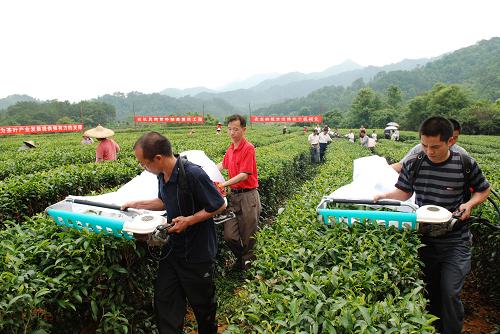
1. Plucking
![]() |
| A nice tea education (It reminds me of my childhood) |
2. Primary Drying
This process is the key to maintaining the natural green color of the tea leaves and liquor. Heat (either dry heat from a pan, tumbler or oven, or steam - which is commonly used in Japan) is applied to arrest any further activity of the enzymatic compounds in the primary leaf and thereby prevent oxidation. This process not only keeps the leaves green, but also increases leaf flexibility, thereby creating a better condition for the next procedure - rolling. Moreover, it helps to remove any grassy odor from the tea and enhance its fragrance.
A special high-grade green tea must be produced by hand in a basket or large wok, but most green teas produced commercially are made largely by machine.
3. Rolling - Shaping
4. Drying
This not only removes the moisture from the tea leaves, but also stabilizes the shape, appearance and quality of the tea, and helps to develop its aroma.
There are three common ways to dry green tea in China: pan-firing, oven-drying and sun-drying. The most famous pan-fired green teas are Longjing (龙井) and Biluochun (碧螺春), mentioned above. The most famous oven-dried green teas are Huangshan Maofeng (黄山毛峰 "Yellow Mountain Fur Peak") and Taiping Houkui (太平猴魁 "Great Peaceful Monkey Chief"). A typical Sun-dried green tea is Dian Qing (滇青 "Yunnan Green") from Yunnan.
In summary, each of these process can be done by hand, partly by hand and by machine, or entirely by machine. The quality and character of any given tea really depends on the technique and taste of the production master, whether produced by hand or machine. Of course, the best quality tea is usually produced by hand.
Since green tea is a fresh product, it should be enjoyed while it's still fresh and full of the life and art carefully brought out by the artisans who produced it. That's why I'm almost out of mine! I'll just have to survive on Pu'er and Oolong until next spring. Later, I'll write something about how their production is different from that of green tea. Bye for now!
Subscribe to:
Posts (Atom)
About Me
- Cha Qu (茶趣)
- Seattle, WA, United States
- I grew up with tea, and it continues to fill my life with so much beauty and discovery, pleasure, peace and friends. It is always leading me toward a greater understanding of culture, nature, myself and others. It is my hope to use this space to share the joy of tea and tea culture with you.