Search This Blog

Sunday, July 15, 2012

2nd Tea Ceremony at Guitian's Tea Club

We broke the ice by broke the table. It was my fault, and it meant to be. That's why we connected each other quickly and we lasted our ceremony until 12:30am. 

We tried 4 kinds of tea plus White cockscomb. We shared the tea poems and discussed them, we talked about the water, the steeping, the beauty, the way of drinking, the tips of choosing a good tea and eating cherries, egg cakes, cookies, France's Chocolate. And more... I know it is kind of boring to list it all. 
However, I gotta some nice photos to share. Enjoy them! And I will specifically address how water effects the taste of tea in a separate post.

At last, special thanks to Mani, Niilartey and Stephen.
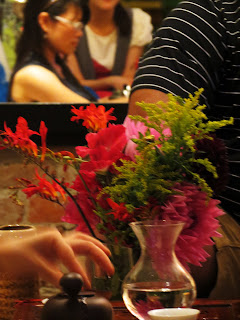
With the wonderful friendly tea savors and gentle music, I was enjoy making tea.

 I was trying to use the tall porcelain pitcher, but I noticed that the pitcher got a smell of the cabinet. Sorry, guys, this was only one time use although it is pretty and holds the aroma for a long time.


We got a professional artistic and fashion designer to film our enjoyment. It will posted soon.

We were having a Puer with the first mushroom sharped clay teapot I connected. The guests complimented that it was so cute and in fact that's why I bought it. The chubby body of the teapot is good for puer tea to expend the flavor and the thickness of the wall is great to hold the heat.

The value of tea brought an awesome group of people at the ceremony:

 The respect of tea, the sincere to the people, enviroment and ritual directly from her eyes. Thanks again!

He sipped the tea though his taste buds, extended it to his mind and took it to his heart!

The attention to the tea doubled the pleasure of the tea!
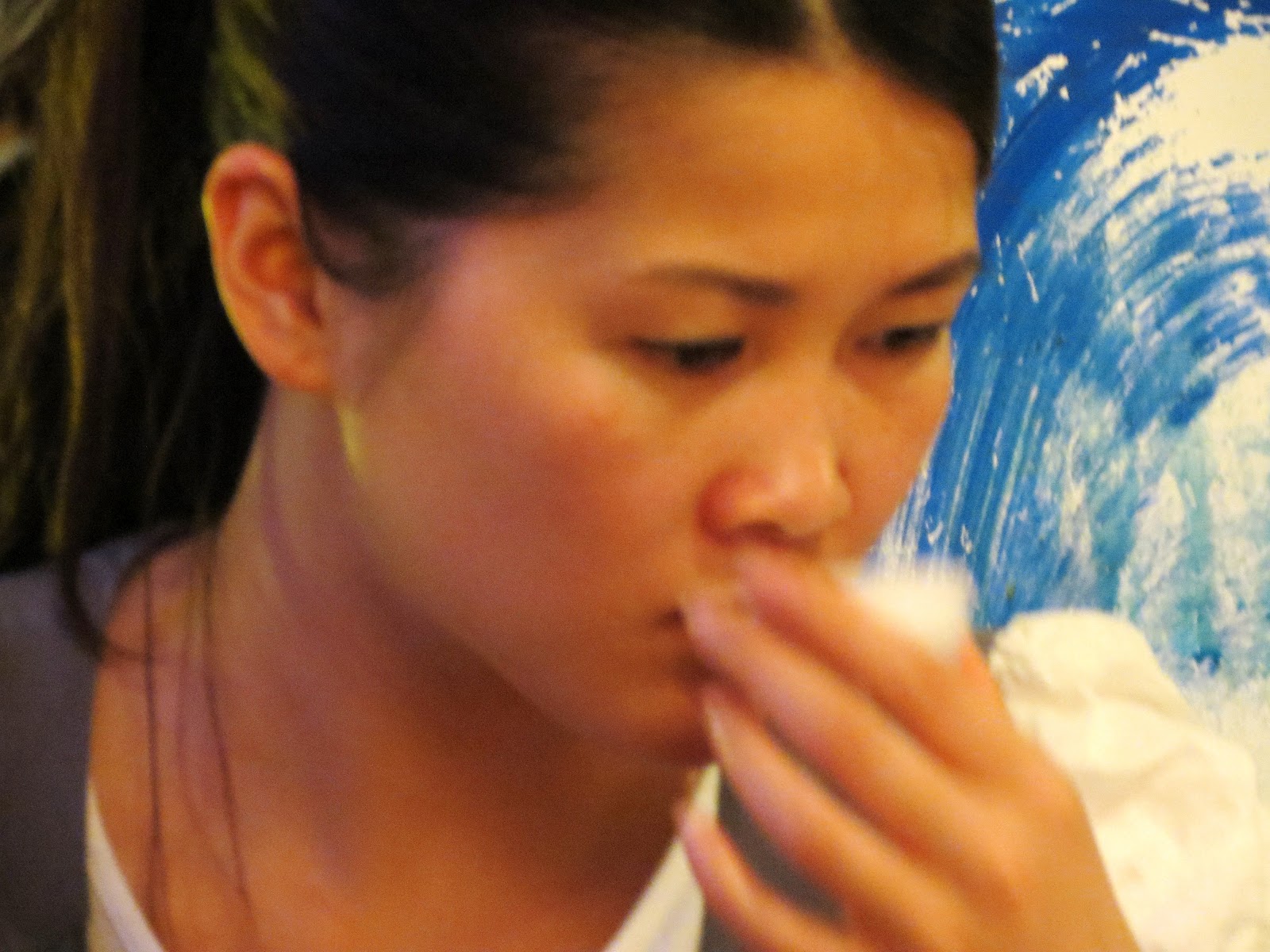
 The elegance of drinking is fully displayed!

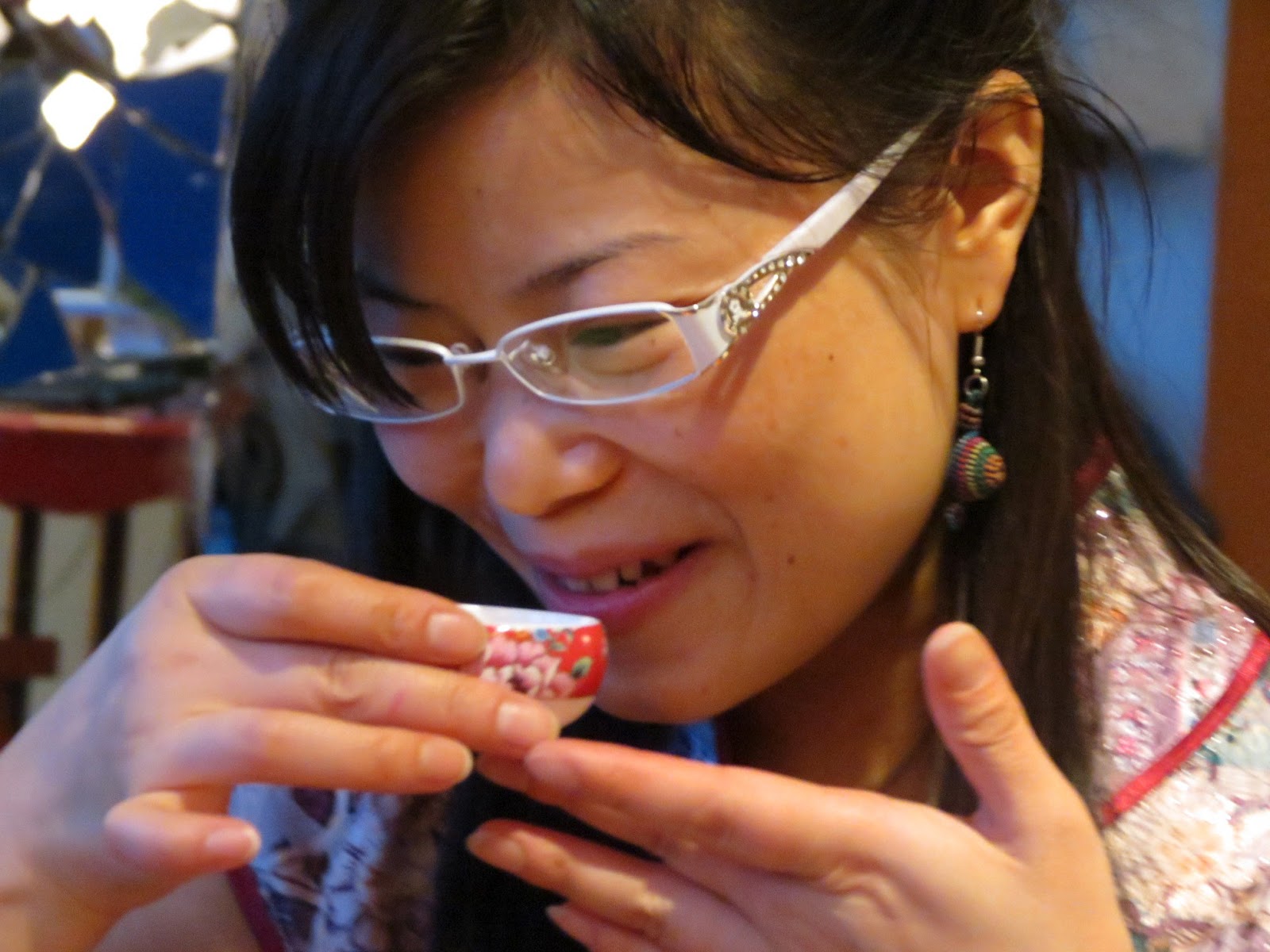
The delightful spirit of her delighted the ceremony. 

 Calmness and mindfulness of him is the purpose of savoring tea.

He was amazing! I was so impressed by his knowledge of all the fine things: wine, cooking, coffee, chocolate, tea and the life. Thank you for your generous sharing, it created great conversations!

The understanding of the Chinese culture (specially like the way he tapped his legs to say thank) and tea (Thank you for cleaning your nose first, took a deep sniff and second sniff to immerse into the aroma of the tea) from him gave me a lot of pleasure and appreciation.

Beauty, health and peace in each cup. When I see how people enjoy their tea, how beautiful the tea itself is, I feel the life is meaning and I wish I were the tea and tea were me.

Serving tea is one of my favorite habit.


I am grateful that tea brings us together and happy to watch how tea brought this sweet couple together.

I got so many photos and posted some of them on Picasa Web Albums, please feel free to click here to see more.
Soon, I will share the video as well.

Wednesday, July 4, 2012

Birth of Guitian's Tea Club

Finally, it happened, and yet successfully and delightfully! I have planned this since last year. Until my dear friend couldn't wait for it any longer, he came over to me, and said, here is the place for you, start it now. Yes, I didn't know what I was waiting for. He is right, if I never give myself a space, there is always a tomorrow, tomorrow.
No excuse any more.

Drinking a lot of tea with an empty stomach could upset the stomach, so the ceremony started with some fresh lychee fruit, sesame balls, red bean cakes and other snacks.


I carefully selected three types of dark tea, and each one has different character. The first one was the Ice Mountain green Puer
cake. The big fat buds and leaves were  compressed consistently with very evident layers. The aroma was surprisingly floral and
more floral than any other puer teas we all experienced. The delicate bright golden color of tea soup lifted our mind up. Here
comes the first sip of the first infusion, it was like a delicate young lady enjoy dancing with her new silk dress. It was flower, subtle, clean, bright, fresh, and delightful. It was a taste of the floating
leaves in a serene clean stream surround by mountains full of flowers. Personally, I love the aftertaste most. The refined sweet aftertaste was gently stimulating my entire mouth, from the mid of my tongue to two sides of my cheek and extended to my throat. After the 3rd infusion, my guests complimented that it was getting more and smoother. When the 4th infusion started, the dancing delicate young lady became a mature educated lady, the complexity of tea was expressing in each sip and sniff. The bitter sweet taste was like the lady went through a lot of tough times, and afterward she overcame the difficulties, the sweetness arrived. After 7 times of infusion, the tea still presented very well balanced. And yet, the beautiful fat consistent wet infused tea leaves were like a pleasant
song in my heart, it tempted me to want to touch and feel the wet leaves by my fingers. So I invited all of us to sense the softness, tenderness and elasticity of the tea leaves.


Second one was a special block of Fuzhan 茯砖-one of a the famous dark teas in China. This particular Fuzhun is in gratitude and memory from the Hunan tea industry to the author of Hunan Dark Tea. This book is the first and the only one book which specifically introduced the full content of Hunan dark tea. The author is a very well known tea master in South of China, is also my tea professor in the Hunan Agricultural University. This special tea has a very limited amount in Chinese market. The best thing to show my respect and
gratitude to my professor is to keep the tea for another 30-50 years and even pass it to my next generation. And, I am very bad about it, because I could not wait any longer. I could not wait to share it with tea lovers. Here it is! The tea was very well compressed.
Breaking the tea was a part of The fun process of making tea art which I do enjoy, like cutting the food before cooking it, it is a part of art. The tea got a unique steamed lotus leaf with a hint of ripe rice flavor. I was trying to explain that it smelled like Zongzi 粽
子 which is a Cantonese lotus leaf rice dumpling. My guests didn't know what Zongzi was and they described it is leafy and earthy. The tea is from 2008 with a mid-body and has a unique distinctive flavor, the complexity of it was hard to describe. After the fourth infusion, the tea became more pronounced, the mouth-feel was more balanced, more smooth, and the aftertaste was more refined as well. And yet, I heard more happy and satisfied gentle voices from my guests. That was a very good sign to me.
 

The third tea was a 1992 aged ripe puer cake. It sent me to a clean ancient rainforest with wild dry flowers and dry fruits. It started as a rich smooth mouth-feel right at the first infusion which is pretty impressive. The typical puer tea generally starts to have this character after or on the 3rd infusion. The aroma of deep earth and complete around silky mouth-feel are my biggest pleasure for this puer. I felt like as if I were lying on many inches of dry falling leaves from ancient trees on the ground in a far away forest and communicating with the mother of Earth. The mellowness of tea absorbed us, it mellowed our bodies and minds. We were melting with tea, with friendship, with nature and peace. We were drinking, we were laughing, and we were celebrating our lives, our joy, and our relationships...


I was so much enjoying seeing the relaxed joyful faces from my guests. To me, seeing people appreciate tea grants me a great pleasure and the value of tea, art and myself. I decided to share my favorite Big Red Robe with them although it wasn't the plan. I was so happy about my decision. It was a perfect ending and conclusion of this ceremony with our purified minds. The aroma was amazingly vivid and the length of bouquet was incredibly long, especially when I used my new tall pitcher. The pitcher kept the dark chocolate fruity fragrance for more than half hour. We were enjoying sniffing the joy of tea aroma therapy and sipping each drop of bliss and harmony.

I smile, of course,
And go on drinking tea.
"Yet with these April sunsets, that somehow recall my buried life, and Paris in the Spring.
I feel immeasurable at peace, and find the world 
To be wonderful and youthful, after all."
                                                   —T.S.Elliot


Drink tea and nourish life; 
with the first sip, joy;
with the second sip, satisfaction,
 with the third sip, peace.


Sunday, June 17, 2012

A New Home of Tea

The rain was like cats and dogs. My thoughts were like cats and dogs too. I was sitting on the bus waiting in traffic and so worried that I wouldn't arrive at my new "home" - a family teahouse called "Three Fate Hall" (三缘堂) - on time. It was my second visit there. Every minute when we shared tea together was so wonderful and precious that we all agreed on my first visit that our meeting together in this space was a family gathering.

Three Fate Hall was the first place I really sat down to drink tea in Changsha. I found it by coincidence while I was looking for a qipao (a type of traditional Chinese dress) although I was crazy about looking for tea houses during my trip in April from the USA to my homeland China.


A simple classic hand-crafted tea set in the warm light of sunshine from a window first attracted my eyes, and the beautiful view caused my feet to follow. Simple cups with an authentic look expressed the richness of culture and history. Seeing them felt like meeting old friend that I hadn't seen for years. After the appreciation of this tea set, I turned around to see other items in the store. A combination of traditional and modem tea-wares with their distinctive but equally beautiful designs filled shelves around the room with an occasional bonsai nestled among them.

A bookshelf with volumes of Chinese calligraphy and a small collection of calligraphy brushes on its left corner added a flavor of literature. Old, dark, natural wooden furniture returned me to the old days of China. The sound of  a little stream of water running over stones next to a tea table provided a reminder of nature. The steam of hot tea was surrounded by a few people and their compliments and laughter were calling my mind, my palate, my feet and very soon my entire body. Without any hesitance, I headed directly to the people who were drinking tea together. As I walked closer, the bouquet of tea was delighting my nose and the enjoyment on the faces of the people was calling my heart louder and louder. My mouth even started to water and I felt like I hadn't had tea for ages! It made me laugh at myself because in fact, I had just returned from a tea expo. Evidently, the unique design of the tea-wares, the setting and atmosphere were lighting up my spirit, to provide an environment I found particularly enticing.

They were having a three-year-old, big-leaf, white tippy raw puer. I invited myself to join them. The host was a friendly young gentleman. He said, we have tea, but we don't have a cup for you, do you have your own cup? I couldn't wait to tell him that I had a cup in my bag, but he continued by telling me I first needed to get a cup in his shop. I was a little disappointed because I sensed that he was trying to sell his stuff. I couldn't believe that he was so materialistic. It didn't match the store and the kindness I sensed from him. Another man came over and introduced different cups to me. The cups no longer looked as refined as I first imagined. I couldn't find any I felt a deep desire for. On the left side of the tea table, there was a very long wooden stool, with a man was sitting on one side. He was drinking his tea from a tiny cream-colored cup with a delicate handle on a little square bamboo tray. The cup looked so comfortable and happy in his hand, and the satisfaction and peace in his heart showed in how gently and carefully he picked it up. Somehow, the cups I had examined became gorgeous again. I chose a cup similar to the one he was using. The host labeled my name on the cup and arranged for me sit on the other side of the long stool, right next to the person (whose name turned out to be Tony) who was using the same style of cup I bought. "From now on," the host said, "this is your cup at our place and there is always tea for you." So simple! I never imagined I could get free tea any time so easily. I was surprised again and felt flattered and of course grateful.


As we sat together, the way I taste tea, and my knowledge, understanding and appreciation of tea opened more and more conversation with the host and the tea drinkers. We started joking, laughing, discussing, and sharing. I shared some of my best purchase from the tea expo, a high-grade Big Red Robe from Fujian. I could see the happiness in their eyes, their relaxed muscles, the lines of their faces, all of this accompanied by the contented sound of slurping. During our conversation, the distance between our seats remained the same, but our hearts walked closer and closer together... We drank, we opened ourselves, we celebrated, we laughed, we illuminated one another. We were drunk from the tea and the people. 

That's why I got so frustrated when I was stuck in the traffic on the bus on the way to Three Fate Hall. Finally, I got off at my bus stop and ran to the place. My heart ran faster than my legs and the rain was so heavy and I didn't have a umbrella. I was so wet, like a poor wet chicken. I knew everything would be worth it. Yes, everything warmed me up after having a cup of tea with my new tea family members. 

Saturday, July 16, 2011

Zen Tea


It finally arrived! A big shipment of tea from my brother, including the type of green tea produced in my village, so that when I opened the package, my entire apartment smelled like my home town. What a sweet feeling! But the most special thing he sent might be the tea from a temple close to my home, which is produced in only extremely limited quantities and only locally made available. It's Chan Cha (禪茶) or "Zen Tea".

This is the tea produced and used by Zen monks during their monastic practice. It has a history that reaches back to the Tang dynasty, when tea first became widespread in China. It forms part of the heart of Chinese tea culture, but you can't buy it in a market. You have to go to a temple to get it.

Before telling you more, let me take a moment to get just a bit philosophical. We live in a world that we can never completely understand. We all go about our lives with only a partial understanding of, well, basically everything. This applies even to things we consider familiar.

For example, after having spent a few years in the United States, my experience here is that many people know the word "tea" without knowing very much about what it is. To them, tea is something that comes in a teabag, of which there are three kinds: black, green and herbal. Some even believe that black tea originally comes from England, and that green tea comes from Japan. (Of course, both green and black tea were originally produced in China, which is where tea culture began.)

Similarly, my experience here is that many people know and use the word "zen" without much understanding of what it means or where it comes from. For them, it represents a general sense of minimalism, stillness and tranquility somehow rooted in obscure East Asian traditions of mysticism. Those who know a bit more frequently believe it refers to a particular Buddhist movement that comes from Japan. They understand it also as a kind of quietude and austere beauty reflecting the essential character of the Japanese people, expressed in traditional Japanese arts such as calligraphy and ink painting, among others.

Like tea, Zen (Chan 禪) comes from China. It is something deeply Chinese that could not have developed anywhere else, and reached its maturity before spreading to Korea and Japan. (As it happens, East Asian calligraphy and ink painting also come from China. It's a country with a rich history.)


Zen Tea is a tea produced and used by monks as an aspect of their practice, which is also made available to members of the lay community when they visit the temple. Zen Tea is grown using methods that are 100% organic and environmentally friendly. This tea is planted by monks, weeded by monks, tilled by monks, pruned by monks, watered by monks, plucked by monks, and processed by monks. The limited quantity produced annually and special steps in its production make Zen Tea extremely precious and rare. The production process of Zen Tea involves not only the same rigorous standards of other famous traditional teas, but also requires that the tea be purified and blessed with a series of eloquent ceremonies intended to develop mindfulness and compassion. 


 Blessing ceremony before harvest time


Purity Blessing Ceremony (灑淨祈福儀式)


In winter there is a purity blessing ceremony (灑淨祈福儀式) which initiates an annual period when the tea garden is closed to visits from the public, so that the plants have a peaceful winter season to rest and develop their energy for more growth in spring. The ceremony itself reminds people to respect and protect the tea plants, as well as life in general. In addition, it expresses gratitude for the gifts of nature and asks that a large harvest might arrive in the coming year. 

In spring, another purity blessing ceremony is held just before the tea harvest. This is to appreciate and praise the sacrifice of the tea plants and the contribution they have made. It also asks that the plants recover quickly from any injury due to plucking and continue to grow in great health. Prior to the purification ceremony, the monks must meditate, light incense, sing, chant, and pray to the Buddha for the protection of all beings.


Buddhism includes the belief that there are numberless unseen beings connected to trees, flowers, grasses and plants such as tea. The monks believe that if they pick the tea heedlessly, it will interrupt or even destroy the lives of these beings. So they chant the Great Compassion Mantra (大悲咒) or other Buddhist mantras while the head monk sprinkles purified water over the area they will enter to pick tea. The head monk then leaves the area, only to walk back and spread water on it one more time. The first time is to inform the beings that the monks are coming so that they may move; the second is to ask forgiveness from the plants and everything alive and express appreciation to them.


After that, an offering of tea is made to heaven; the monks contemplate Buddha and read sutras. Finally, they change clothes to harvest the tea. The buds must be plucked without harming any other part of the tea plants or their environment. Every movement should be conscious, every step careful not to hurt or kill anything living on the ground. For the monks, the harvest forms part of their meditation. The entire process of tea production is structured to help develop patience, conscientiousness, empathy, purity and peace.


For me personally, the more I learn about tea, the more I find to appreciate. Particularly with Zen Tea, each sip, every breath becomes so important if we just pay attention to it. I'm very grateful to those who give their lives to this tradition, because its gift is to help make me aware of the endless beauty we live in.
The Classic of Tea (Chajing 茶经)

Tea has had an intimate connection with Zen for many generations. Every tea drinker has heard the name of Luyu (陆羽), also called "the Sage of Tea", who wrote The Classic of Tea (Chajing 茶经), the first definitive work on tea production, preparation and etiquette. He was abandoned as a baby and adopted by the abbot of a Zen temple. Luyu grew up in the temple, raised by the master, where he learned about tea and medicinal herbs and where he prepared tea for his master on a daily basis. Although he later left the temple, this experience stayed with him, and it is in large part due to this early training that he later became famous.

Of course, the relationship between tea and Zen did not begin with Luyu. Tea had been incorporated into Chinese Buddhist practice even preceding the development of Zen in the Tang Dynasty (about 1800 years ago). This means tea has had a connection to Zen since its beginning. In fact, when we see a temple in China, we assume it also has decent tea. There is an ancient saying: "Tea and Zen share the same flavor; tea and monks share the same fate; tea and temples share the same place." (“茶禪一味、茶僧一緣、茶寺一體.”)

In China we say: "Where there is a good mountain, there is a good temple; where there is a good temple, there is good tea." Monks typically live close to pristine nature: on a high mountain with mist and clouds, with rich soil and ancient trees, beautiful flowers and clean water. Making tea as a monk is not for business but as a part of practice and meditation. Now I understand why many of the most famous teas (e.g. Fo Cha "Buddha tea", Tie Guanyin "Iron Goddess", Da hong Pao "Big Red Robe", Longjing "Dragon Well" etc.) were originally developed by monks.
 

Monks have to sit hour after hour, day after day for meditation. Younger ones eventually fall asleep, older ones sooner or later lose energy; tea keeps them focused, helps them stay awake and gives them energy. For example, after eating, mental concentration drops as energy goes to digestion. It is a challenge to sit after a meal without just becoming a potato. Tea helps prevent the monks from becoming potatoes and supports both digestion and circulation.

Due to its many benefits, tea has remained in the temple for dynasty after dynasty. Today, tea is still integral to the rituals and practices with which monks develop themselves. It lends itself to etiquette, purifies the mind, lifts the spirit, improves general well-being, strengthens character, and helps to develop self-discipline, inspiration and finally enlightenment - or so I'm told, not having had this experience myself.

Zen Tea is separated into three grades: high grade, mid-grade and standard grade. Different grades serve different purposes. High grade tea is offered to heaven in ceremonies; mid-grade tea is served to members of the lay community, and standard grade tea is what the monks retain for themselves. In case this seems at all strange, let me say that considering others first is actually basic etiquette in China. We always serve tea to others first and ourselves last. For example, my parents always save the best tea they make themselves for their children, friends, relatives, or special guests - so what do they drink every day? Whatever is left that they don't want to throw away.

So, the package of tea from my family includes some of the best tea from my home town, and the best Zen Tea made available to the public. It isn't sold openly. Because my family has a connection to the temple close to my home, they were able to get some. Of course, they had to go to the temple to get it.

There are many fascinating anecdotes involving Zen and tea, and I very much want to share some of my favorites with you, but right now, after having written this much, I'm ready to sit with a small pot of the tea sent from the temple, just to relax and refresh myself. It's very helpful just to have a short moment to remember what's most important. Just one cup of tea helps put everything in perspective. We have so much to be grateful for!


Tuesday, March 1, 2011

How to store your puerh tea

I was so excited! One of my friends invited me to taste a puerh tea produced in the 1980s. The cake had just arrived from China, and in a week we would meet to share it together. This week seemed neverending. When the date we set finally arrived, I raced to his place for a taste of something genuinely special.

After eagerly opening the paper wrapper, I noticed some white spots spread unevenly over the surface of the tea. This elicited my first concern about its quality. Raising the cake for better inspection, my excitement was stifled by the odor of mold. This stink was immediate and conclusive proof that the tea had been tainted due to poor storage. I didn't want to disappoint my friend so quickly and kept my silence as I carefully separated the cake and prepared the tea. The liquor was dull and dark like ink. The flavor was muddy and moldy. It all confirmed my original suspicion that the tea had been contaminated.

How did this happen? The tea was stored in an overly warm and moist environment, either due to negligence or perhaps to hasten fermentation. As a result, the amount of moisture the tea absorbed rose over 10% of its total mass, creating felicitous conditions for growing mold. In China, it is not unusual to use warmth and moisture to mature puerh while it is in storage, although they are supposed to be controlled. We even have a professional term for this: "wet-stored" (shicang 湿仓) puerh. As one might suspect, the alternative is known as "dry-stored" (gancang 干仓) puerh.

Of course, it is both very disappointing and frustrating to age a cake for decades, only to grow mold, or produce what should have been a delicacy and is now only compost. So what are the significant points we should know to store our tea properly?


1. Air Circulation is necessary 

Don't store puerh in a plastic bag or airtight container, because the microbes that cause fermentation need to breathe. Constant and regular air circulation will help the tea develop and blow away odors. However, puerh should not be kept anywhere breezy (e.g. next to a window, doorway, or on a balcony), as the wind will carry its aroma and flavor away. In sum, moderate air flow is important, but drafts should be avoided.


2. Constant Temperature is necessary

The best temperature to store puerh is between 68-86°F (20-30° C). If the temperature is too high, it will affect the mouthfeel. The taste could become dull, flat or sour. In addition, raw (sheng 生) puerh will sometimes develop into cooked (shu 熟) puerh (this has been reported for tea stored in Hong Kong). This means a normal indoor temperature for us would be suitable for puerh as well.


3. Moderate Humidity is necessary 

As mentioned above, puerh is divided into two kinds according to storage method: "dry-stored" puerh (gancang puerh 干仓普洱) and "wet-stored" puerh (shicang puerh 湿仓普洱). The former refers to tea allowed to ferment naturally in an environment that is relatively dry, ventilated, and moderately hot; the latter refers to tea aged in an environment with low ventilation and high humidity in order to hasten development. This is done sometimes because the tea producer can make more profit on it. 

                                                                    "Dry stored" puerh

                                                                  "Wet-stored" puerh


If the environment is too dry, it will slow down the ageing process. So if conditions where you live and keep your tea are dry (e.g. maybe you live in a desert or alpine environment), you can put a glass of water next to your puerh, to increase the nearby humidity slightly. Alternately, if conditions are too humid, it will typically result in mold, as happened to the tea I tried at my friend's house.


4. Avoid any odor 


Tea is very good at absorbing any kind of odor. Not long ago, I bought a second-hand dress that had a strong unpleasant smell. I didn't want the stench to spread to the rest of my clothes, so I left some loose tea leaves in the dresser drawer. A few days later, the tea had the strong smell of the dress, which itself smelled better than before. My advice is that you should never store your tea, no matter what kind, in an environment that has any other scents whatsoever.


5. Material to wrap the tea

Imagine tea has a life like us and needs to breathe. Pack your tea in something made from a permeable material, such as organic nonwoven bags, kraft paper bags, paper towels, wooden or cardboard boxes, bamboo baskets or husks, clay or porcelain containers, and so on. I strongly recommend you do not put puerh tea in a plastic bag if you are planning to store your tea for years. Moreover, do not keep tea in a metal container. Remember that whatever packaging you choose should have no other smell.


Once you understand puerh as having a life just like us, it becomes easier to see how to keep it alive. It should have a comfortable place to stay; somewhere not too fancy or complicated. There is no need for refrigeration (remember I am talking about puerh, not green tea), no need to seal it in an airtight container, no special equipment and no direct sunlight. You can store it in your study room where there are no other smells and some air moves through. If the room is too dry or humid, it is better to open the window once in a while. In Pacific Northwest weather or during a monsoon, the tea has a greater chance of growing moldy, so remember to examine it occasionally. Finally, I want to remind you yet again that you should never keep your tea in an area with other smells, such as a bathroom, kitchen, new cabinet, drawer holding soap, incense, etc. Moreover, you should understand that puerh cakes from the same production line will have different aromas and tastes because they have been aged in different conditions. Decades after they are made, one from Yunnan will never be the same as one from Hong Kong, Taiwan or the USA.

One final aside is that you should not store cooked and raw puerh together.


I am sure if you follow these rules to store your puerh tea, the tea will be safe and develop well. Enjoy it, and don't forget to invite me by for a sip! :)


About Me

My photo
Seattle, WA, United States
I grew up with tea, and it continues to fill my life with so much beauty and discovery, pleasure, peace and friends. It is always leading me toward a greater understanding of culture, nature, myself and others. It is my hope to use this space to share the joy of tea and tea culture with you.